Nasdaq 21,000 Collapse and the Mid-East War: Crisis or Opportunity?
Secure Your Returns in a Volatile Market with Data-Driven DCA (Dollar-Cost Averaging)
Good evening. As we look at the global market’s downward indicators this weekend, it is a critical time to deeply reflect on the market’s future direction.
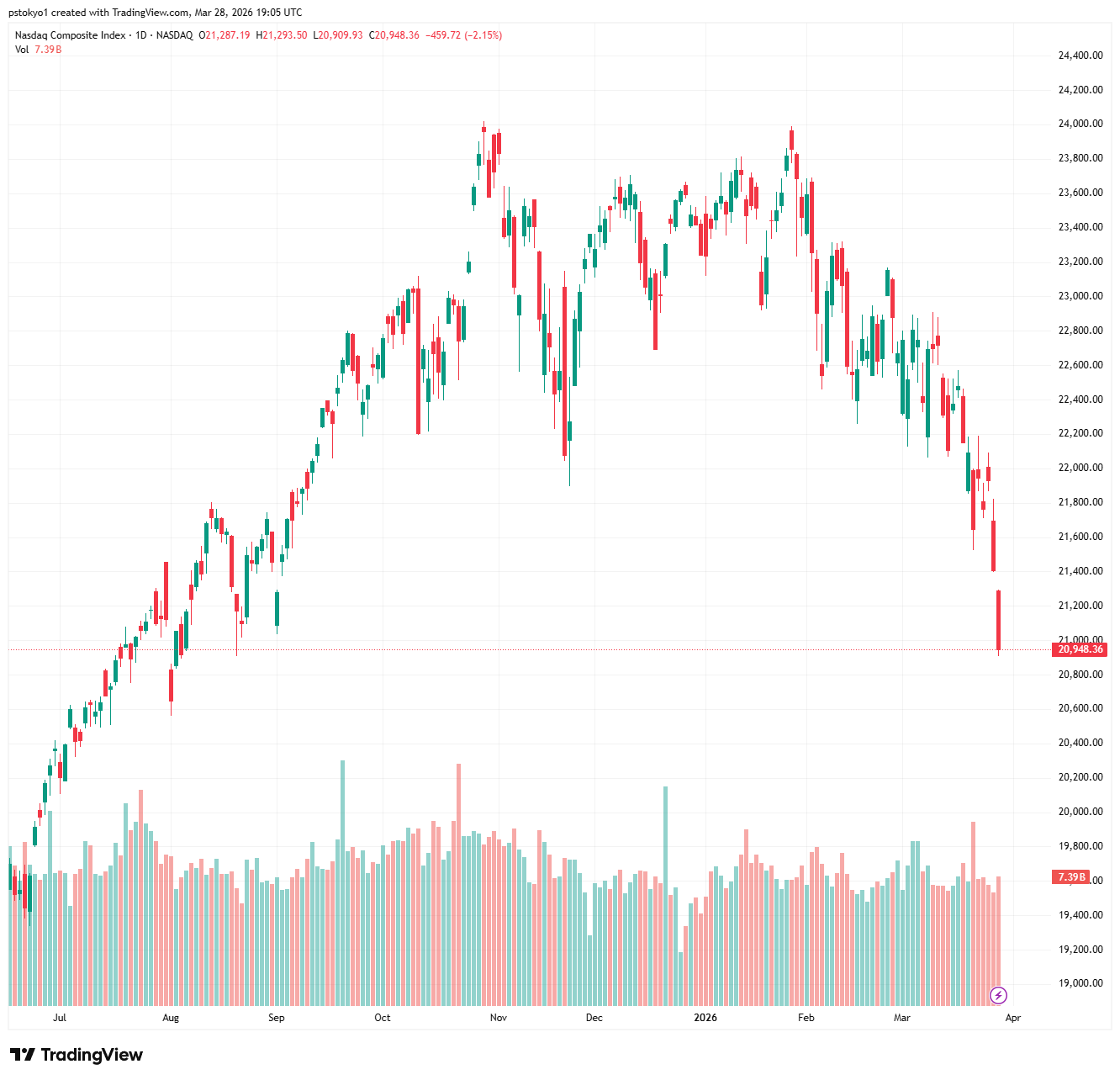
The current market is shrouded in uncertainty. Geopolitical risks involving Iran show signs of becoming prolonged, and the Nasdaq closed after breaking below the 21,000 level—a psychological “Maginot Line” for tech stocks. In this chaotic market, I would like to share my analysis and personal thoughts on how individual investors can protect their assets and capture new opportunities.
—
📉 3 Core Reasons for the Market Cooling
The recent downturn is not a simple correction; it is the result of a combination of “external fear” and “internal skepticism”.
1. Normalized Geopolitical Risks: Concerns over an escalation of the Middle East war have led to sustained instability in oil prices and supply chains. This has fueled inflationary pressures, causing the S&P 500 to face strong resistance around the 6,300 level.
2. Fundamental Doubts About AI Profitability: As the pace of new investment in companies like OpenAI has moderated, the market is increasingly questioning when the AI industry will translate into actual revenue.
3. Profit-taking in the Semiconductor Sector: Key AI infrastructure players, including Micron (MU), are trending downward, dampening investor sentiment across the tech sector.
🚀 A Downturn is the Best Time for Portfolio Rebalancing
While the cooling of an overheated market is painful, from a long-term perspective, it presents an opportunity to purchase high-quality assets at a discount. The grand paradigm of AI innovating efficiency across all industries is not something that will be broken by a temporary dip in market indices.
—
🛠️ Practical Action Guide: Advanced DCA (Dollar-Cost Averaging) Strategy
In times of high uncertainty, committing all your capital at once is equivalent to abandoning risk management. A meticulously calculated Dollar-Cost Averaging (DCA) strategy is essential.
1. Translate Fear into Price Indicators
* Interpret the Nasdaq 21,000 collapse not as a signal of panic, but as an entry into an “attractive buying zone”.
* It is advisable to mechanically expand your positions whenever core stocks drop due to macro issues, provided their fundamentals remain unchanged.
2. Focus on Industry Fundamentals
* War is a temporary external variable. However, the expansion of data centers and the demand for high-performance semiconductors are a confirmed future for years to come. You must separate short-term noise from long-term trends.
3. Manage Your Mindset Based on Objective Metrics
* Instead of reacting emotionally to daily fluctuations, it is better to establish your own yield monitoring system. From a long-term growth perspective, the current decline will eventually appear as nothing more than a small valley.
> 💡 Investment Principle Summary
> “When the market is gripped by irrational fear, a wise investor responds with the coldest data.”
—
🌟 Conclusion: The Patient Investor Wins
– Current Situation: High macroeconomic instability, but excessive pessimism should be avoided.
– Recommended Action: Maintain a phased Dollar-Cost Averaging approach for high-quality AI stocks.
– Core Value: War is merely a variable; the AI revolution is an irreversible, era-defining shift.
“Do you view the current correction as a ‘bursting bubble’ or a ‘stepping stone for a bigger leap’? I look forward to hearing your insights in the comments.”
